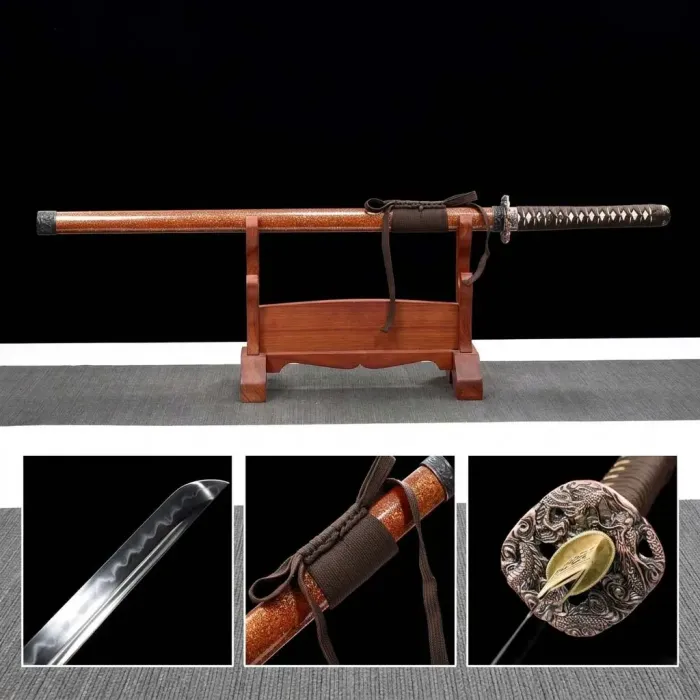
Each classic oriental sword acts as a stunning expression of ingenuity, but imagine you desire to communicate your personal design? Modifying your instrument is a meaningful journey, allowing you to fashion a truly exceptional piece. From the grasp wrapping and fitting to the covering design and edge design, each segment offers a chance for bespoke design. This investigation delves into the sphere of katana modifications, providing guidance for both rookies and seasoned enthusiasts aiming to form their legacy on the long-standing art of the samurai.
1060 Steel Katanas: The Beginner's Original Fabrication
For people ready to embark on the rewarding journey of katana handling skills , 1060 steel katanas present an ideal entry point. This chosen grade of fundamental steel meets a golden mean between budget-friendliness and functionality . While inferior to hard as leading steels, 1060 allows for a manageable level of blade refinement , making it tailored to initiates to learn the core principles of edge management and understand the attractiveness of authentic Japanese weaponry. It’s a wonderful choice for gaining experience without the monetary burden of more high-grade steels.
T Ten Alloy Weapons : Optimizing Potency and Affordability
For enthusiasts seeking an authentic sword experience without exceeding the wallet , T10 metal katanas represent a attractive option. These blades offer a reasonable improvement in resilience compared to less expensive alternatives, exhibiting acceptable edge retention and adequate flexibility for introductory cutting techniques. While not rivaling the superior characteristics of fine steels like T100 or folded compound, T10 provides a admirable blend of effectiveness and reasonableness , making them a trendy choice for novices and those on a tight budget .
Beyond the Metal: Refining Your Edge's Components and Handle
Although the glazed metallic edge is undeniably the core point of a katana, truly enhancing its beauty lies in the exact customization of its details and hilt . This practice allows devotees to exhibit their distinct style . Weigh the broad possibilities: menuki - decorative adornments that introduce visual detail ; the hamon wrappings – often elaborately crafted ; the tsuka foundation itself, wrapped in customary ito braid ; and the fusa finial , which can be fashioned from various matter like alloys or bone .
- Prefer designs that connect with you.
- Evaluate with diverse mediums.
- Highlight quality for a persistent impact .
The Enchantment of the Katana: Past, Crafting, and Elements
This traditional armament retains a incomparable allure, steeped in epochs of Asian history and tradition . More than merely a instrument of hostilities , it's a representation of the knight ethos – a fusion of prowess and self-control . Its growth spanned score generations, with early swords evolving into the polished curvature and precise edge we acknowledge today. The workmanship involved is truly impressive , requiring years of study to become skilled in . The process involves a multifaceted folding of steel bloom , creating layers that boost the steel’s flexibility and slicing ability. Diverse schools of crafting came about , each with their own secrets and processes for achieving the optimal harmony and cleanness - a truly heavy pursuit.
- Early Katana forms
- The purpose of the samurai blade in fighter class culture
- Conventional manufacturing practices
Selecting the Best Steel for Your Japanese Sword Project: 1060 vs. T10
Deciding on the ideal steel is vitally important for any cutting weapon project, and the determination between 1060 and T10 can be complicated. 1060 is a prevalent American compound, offering a fair balance of resilience and sturdiness, causing it somewhat easy to process. However, T10, a Nipponese steel, commonly boasts enhanced wear longevity and can possibly achieve a greater final hardness, although it can be more difficult to apply and requires detailed heat forging. Consider your competency and targeted effects: for a newcomer, 1060 may be a custom katana more origin, while the expert smith might admire the supplementary attributes of T10.
- Simplicity of Working
- Endurance
- Decisive Rigidity
Discovering Power: Refined Katana Adaptation Practices
Excelling in the craft of sword improvement extends far beyond basic grinding. Serious experts are now exploring advanced techniques to truly release a blade's hidden potential. This requires intricate work with the temper line, utilizing specialized compositions for differential strengthening and carefully choosing the design of the defense plate to optimize balance and handling. Beyond purely functional tweaks, artisans are increasingly focused on attaining unparalleled aesthetic appeal, through complex cutting and layered coatings that truly transform a katana into a artistic composition.
From Elemental Metal to Artistry: Forging a 1060 Blade
The journey launches with typical 1060 substance, a resilient material far lacking the elegant katana it will develop into. Expert bladesmiths perform a complicated process of uniting and crafting the primary steel, repeatedly raising it and pressing it to eliminate impurities and generate a balanced grain structure. This laborious process, often persisting for days , builds the required force and pliability characteristic of a bona fide Japanese tool. Subsequent heat adjustments , including careful hardening and quenching , are fundamental to achieve the expected harmony of sharpness, permanence and magnificence.- Layering: Minimizes impurities and generates grain structure.
- Forging: Models the steel into the initial blade form.
- Conditioning: Regulates the final hardness and flexibility.
The Enduring Appeal of the Katana: A Deep Dive into Steel and Customization
An historic katana holds present a intense symbol of Japanese heritage , its charm far outshining mere artillery . Forged from select steel and often featuring intricate designs , the technique of creation itself is a respected art. Beyond the primary craftsmanship, the ability to adapt a katana - from the quench mark to the shaft wrapping and fastening - provides for a wholeheartedly individual exhibition for both curators and practitioners alike. This combination of ancient steelwork and boundless personalization leads the katana's continued appeal across the world .